
Why Aging Buildings Don’t Fail All at Once—They Fail in Patterns
- A.Weiser Marketing
- Apr 11
- 3 min read

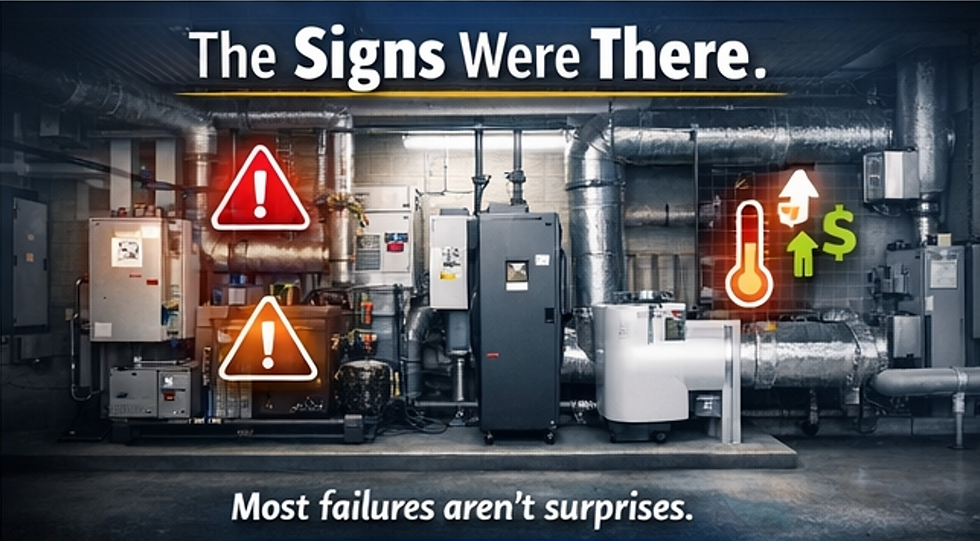
The Myth of “Sudden” Building Failure
When a building system goes down—whether it’s HVAC, plumbing, or electrical—the reaction is often the same: “It just failed out of nowhere.”
But in reality, buildings rarely fail all at once. Especially in aging facilities, breakdowns follow predictable patterns. The problem isn’t that the failure was sudden—it’s that the warning signs were missed, misunderstood, or ignored.
For facility managers and building owners, recognizing these patterns can mean the difference between proactive planning and costly emergency repairs.
Buildings Age Like Systems—Not Components
A common misconception is that equipment fails independently. In reality, building systems are deeply interconnected.
When one component degrades, it puts stress on others:
An aging air handling unit forces rooftop units to work harder
Failing control systems cause inconsistent performance across zones
Undersized or deteriorating piping impacts heating and cooling efficiency
Over time, this creates a ripple effect. What starts as a minor issue evolves into a system-wide strain.
Key takeaway: Failure isn’t random—it’s cumulative.
The 3 Most Common Failure Patterns in Aging Buildings
1. The “Domino Effect”
This is one of the most common patterns we see in older facilities.
It starts with a single point of failure—often something small:
A failing pump
A stuck damper
A sensor giving bad data
That one issue causes other components to compensate. Systems begin operating outside their intended range, accelerating wear and tear across the board.
Eventually, multiple failures occur in a short window, creating the illusion of a sudden breakdown.
In reality: the first domino fell months—or even years—earlier.
2. The “Seasonal Stress Test”
Many systems appear to function fine… until peak demand hits.
Cooling systems fail during the first major heatwave
Heating systems struggle during extreme cold snaps
Ventilation issues surface when occupancy increases
Why? Because aging equipment often operates adequately under normal conditions but cannot handle peak loads.
This pattern is especially common in:
Schools
Hospitals
Commercial office buildings
What it means: If your system only struggles during extremes, it’s already telling you it’s near the edge.
3. The “Deferred Maintenance Spiral”
When maintenance gets delayed—whether due to budget constraints or operational priorities—small issues compound over time.
Dirty coils reduce efficiency
Worn belts strain motors
Minor leaks turn into major failures
As performance drops, energy consumption rises. Systems run longer and harder, increasing the likelihood of breakdowns.
Eventually, the cost of reactive repairs far exceeds what proactive maintenance would have been.
This pattern is avoidable—but only with consistency.
Why Pattern Recognition Matters
Understanding how buildings fail changes how you manage them.
Instead of reacting to emergencies, you can:
Forecast capital expenditures more accurately
Prioritize upgrades based on risk—not just age
Reduce downtime and disruption for occupants
Most importantly, you gain control over your building’s lifecycle instead of letting failures dictate your schedule.
What to Watch For: Early Warning Signs
If your building is aging, these signals often indicate a pattern already in motion:
Increasing frequency of service calls
Inconsistent temperatures across spaces
Rising energy bills without increased usage
Equipment running longer cycles than normal
Complaints from occupants becoming more frequent
Individually, these may seem minor. Together, they form a clear pattern.
How H&W Mechanical Helps Break the Cycle
At H&W Mechanical Services, we don’t just fix what’s broken—we look at the full system to identify failure patterns before they escalate.
Our approach includes:
System-wide assessments to uncover hidden dependencies
Data-driven maintenance strategies tailored to your facility
Phased upgrade planning to spread costs and reduce disruption
Real-world field insight from decades of hands-on experience
We help clients move from reactive to strategic—so failures don’t come as surprises.
Final Thought: Patterns Are Predictable—If You Know Where to Look
Aging buildings don’t fail overnight. They send signals, follow patterns, and escalate in ways that can be anticipated.
The question isn’t whether your building will experience failure—it’s whether you’ll recognize the pattern early enough to do something about it.
Looking Ahead?
If your facility is showing signs of strain, now is the time to evaluate—not after the next breakdown.
Let’s identify the pattern before it becomes a problem.


Comments